The origins of tarot reach back to fifteenth-century Italy, when the cards were played in a game of courtly entertainment called Tarocchi, similar to Bridge. The four suits — coins, cups, swords and wands — were supplemented by a set of trump cards with unique imagery drawn from the surrounding culture, such as the Emperor, the Magician, or Judgement. In the late eighteenth century, the rich appearance of these cards first gave rise to tarot card divination, or cartomancy. The twenty-two trump cards came to be known as the Major Arcana and the fifty-six suit cards as the Minor Arcana (meaning, the Greater Mysteries and the Lesser Mysteries). Since then tarot decks chiefly have become a tool for considering human problems through the lenses of symbolism and chance, rather than with linear, rational analysis. To borrow a phrase from the anthropologist Clifford Geertz, tarot cards are “good to think with.”
As tarot has continued into the present day, the challenge of the reader must be to bend the cards’ traditional associations towards the emerging concerns of our era. We face issues that are distinctive to our time, alongside those of perennial human interest like love, family dynamics, or career. Modern cartomancers must consider new forms of hierarchy and liberation; of creativity and power. Shifts in gender, sexual, and relationship norms, as well as global challenges such as climate change, shape our modern lives. In short: tarot has strong roots, but evolves in tandem with culture. While my reading practice specializes in bringing tarot into the twenty-first century, my training as a professional historian also requires me to show full respect for tarot’s historical complexities.
*********************************************************************************
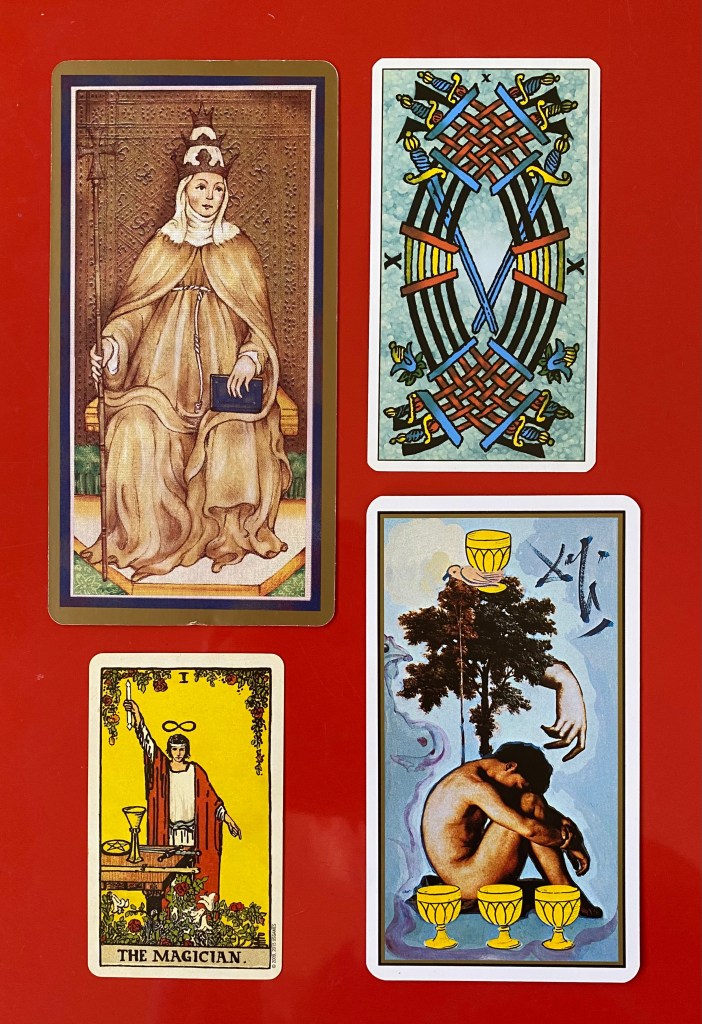
The Popess from the Visconti-Sforza deck (1450/51, Italy); the Ten of Swords from the Marseille deck (c. 1639, France); the Magician from the Rider-Waite-Smith deck (1909, Britain); and the Four of Cups from a deck created by Salvador Dalí (1984, Spain).
 Home
Home 